Welcome to the era where computers don’t just play chess — they design medicines. From outsmarting superbugs to poking at the mystery of Parkinson’s and finding new uses for dusty old pills, AI is quietly turning the pharmaceutical world into a playground of possibility. It’s messy, exciting, and yes, a little bit sci‑fi.
When antibiotics stop working, panic rings
We’ve been losing the war against bacteria for decades. Antibiotic resistance is spreading, and infections that were once simple to treat are becoming dangerous again. Rough estimates say about 1.1 million people die each year from infections that used to be easy to cure, and if nothing changes that number could climb dramatically by midcentury.
Making brand‑new antibiotics is slow, costly and, frankly, not very fashionable for big drug companies — so progress has been painfully limited. Between 2017 and 2022 only a handful of new antibiotics made it to approval, many of them variations on old themes that bacteria are already learning to dodge.
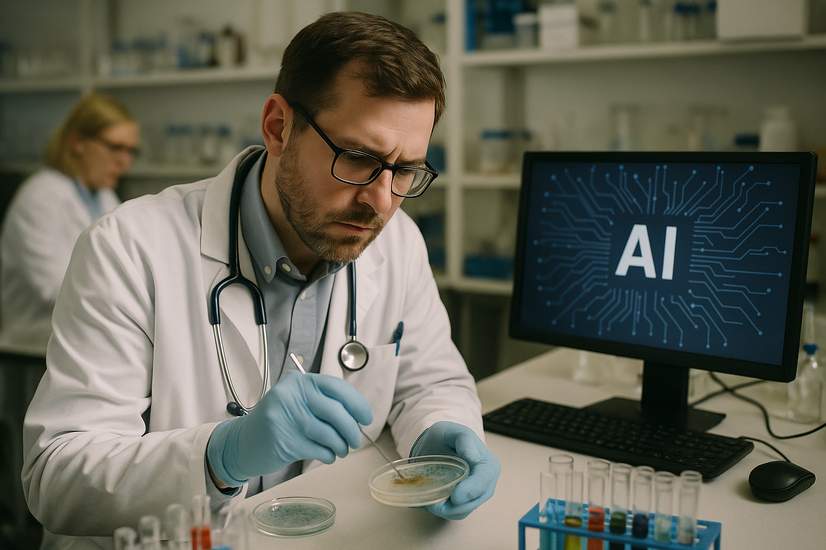
Enter AI. Instead of the old needle‑in‑a‑haystack grind, researchers can now teach algorithms what an antibiotic looks like, then unleash them to comb through millions of chemical structures in days rather than years.
Code meets chemistry: building brand‑new bug killers
Teams at places like MIT trained generative models on known antibiotic molecules so the AI could learn the chemical patterns that make bacteria squirm. The system then scanned tens of millions of candidate molecules and even designed millions more from scratch — sometimes by growing a starting molecule piece by piece, sometimes by letting the algorithm freestyle.
Of the vast virtual crop they grew, a tiny set was actually synthesised and tested in the lab. A few showed antimicrobial activity and a couple were especially good at killing strains that shrug off other drugs — think drug‑resistant gonorrhoea and MRSA. Even better: these new compounds seem to hit bacteria in novel ways, which is exactly what you want when the usual weapons have lost their edge.
Parkinson’s: trying to stop the slide before it starts
Parkinson’s has been known for centuries, but we still don’t have a treatment that reliably slows the disease’s march. Millions are affected worldwide and the hunt for a true disease‑modifying drug has been full of false starts, partly because researchers still debate what actually kicks the whole thing off.
That’s where machine learning comes in. Instead of blindly testing compounds, scientists fed an algorithm examples of molecules that seemed promising against the misfolded protein clumps (Lewy bodies) linked to Parkinson’s. The AI suggested new small molecules that could squeeze through the blood‑brain barrier and bind to those proteins.
Researchers tested the AI picks in the lab, fed the outcomes back into the model, and repeated — the classic feedback loop. The result: several novel candidate compounds identified faster and cheaper than old‑school methods would allow. The goal now is to stabilise the normal form of the proteins so they never assemble into the toxic aggregates in the first place — prevention beats cure, right?
Old drugs, new personalities
Not every breakthrough needs a brand‑new molecule. Sometimes the right answer is already sitting on a pharmacy shelf with a different name. A dramatic real‑life example: a doctor‑scientist with a rare immune condition experimented with an existing drug normally used after kidney transplants and managed to pull himself back from the brink. That kind of thinking — repurposing approved medicines — avoids a lot of the safety hurdles and can get treatments to patients faster.
People have started using AI to match thousands of approved drugs to thousands of diseases. Projects have flagged thousands of possible repurposing ideas, including options for rare disorders that big pharma often ignores. For patients with unusual conditions, that kind of shortcut can be life‑changing.
Virtual diseases and running experiments in silico
Some groups are going further and building ‘virtual disease’ models. By sequencing cells from healthy and diseased lungs, for example, researchers can map how cells change during progressive conditions like idiopathic pulmonary fibrosis (IPF). AI can then simulate those transitions, point to biomarkers, and even test how different drugs would behave in the virtual system.
That approach recently suggested several candidate treatments for IPF, including an existing blood‑pressure medication that might be repurposed. Other companies using AI have also designed drug candidates that are now moving through clinical trials, showing the whole pipeline isn’t purely theoretical.
So what’s the catch?
AI is powerful, but it’s not a magic wand. A lot of crucial drug data — absorption, distribution, toxicity — is locked up in private company vaults, which can limit how well models perform. Also, AI shines at early stages: finding targets, proposing molecules, prioritising leads. But getting from a promising molecule to a safe, effective medicine in a human is still a long road with many checkpoints.
In short: AI is turbocharging discovery in very specific ways, slashing time and cost in the early game, but real‑world success still needs lab work, clinical trials and a heap of patience.
Why we should be cautiously optimistic
It’s tempting to picture robots handing us cures overnight, but reality is both humbler and more exciting: algorithms are giving researchers shortcuts and fresh ideas that humans alone might never have found. Whether it’s outsmarting superbugs, nudging misbehaving proteins back into line, or giving old drugs new gigs, AI is making previously impossible experiments possible.
So yes — the revolution is limited, noisy and full of caveats. But it’s real. And if the next decade brings a handful of new antibiotics, a treatment that slows Parkinson’s, or repurposed medicines that save lives, that’ll be more than enough reason to celebrate (socially distanced, with hand sanitizer and a sense of wonder).