Why everyone had an opinion about Monty
Bernard “Monty” Montgomery is one of those larger-than-life wartime characters: equal parts strategist, showman and occasional braggart. By the time he died in March 1976 aged 88 he’d spent decades polarising people — adored by many of his men, loathed or mocked by some of his allies, and endlessly fascinating to writers and broadcasters.
Caravan strategy and the Desert Fox
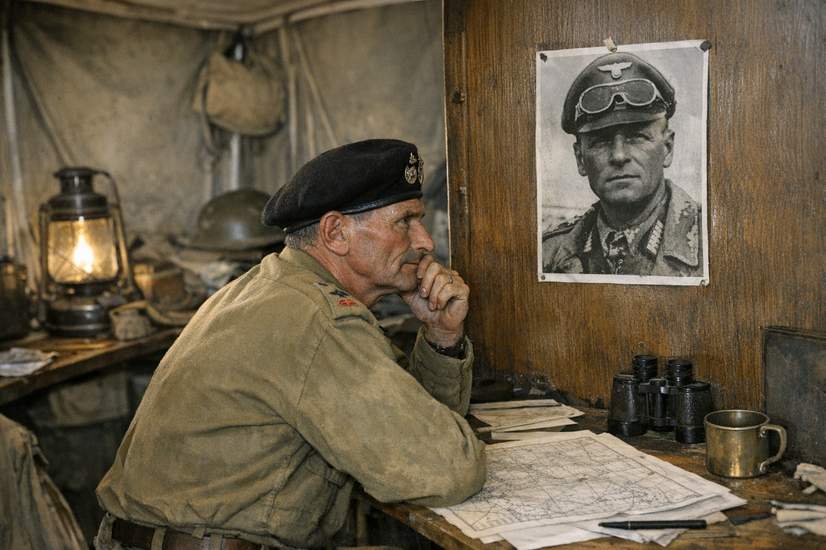
When Monty turned up in Egypt in July 1942 he brought a very particular brand of confidence. He even kept a photo of his main rival, Field Marshal Erwin Rommel (the so-called “Desert Fox”), pinned up in his caravan and would stare at it, trying to think a few moves ahead. It was part theatrics, part practical mental chess: what would Rommel do if Monty tried X? Spoiler — it helped him plan.
From “white knees” to firm orders
Veteran desert soldiers had a nickname for pale newcomers — “white knees” — and Monty got that label at first. He shrugged it off by hauling himself around the front line, speaking to units and laying down a new mood: no more running away, no more muddle. He told the troops they were done with retreats and injected a strong, almost theatrical certainty into the campaign, which lifted morale faster than new equipment ever could.
The El Alamein blueprint: three neat acts
Monty believed in planning until it hummed. He told his men the plan would unfold in three stages: punch through the enemy lines, fight it out in the messy middle, then burst out and chase the beaten foe. To make that happen he spent weeks drilling, reorganising supplies and making sure his logistics matched his ambitions. In short: clever administration behind the lines so the front could actually do the flashy stuff.
Big guns, mines and Lightfoot
By late October 1942 he was ready to strike. The assault opened with a colossal bombardment — the biggest Britain had seen since the First World War — and then engineers went to work clearing lanes through thick minefields so the tanks could pass. That first phase was nicknamed Operation Lightfoot. Heavy losses piled up on both sides, but the Allies had the numbers and, crucially, Rommel’s supply situation was getting dire.
Supercharge and the turning point
A few nights later, Operation Supercharge pushed armoured divisions through the remaining defensive belts. The fighting was brutal and costly — some tank units were almost wiped out — but the pressure broke the Axis formations. Rommel’s striking force shrank dramatically as tanks were lost or ran out of fuel, and many of his infantry were captured when the mobile units couldn’t cover them. Within months the Axis presence in North Africa had collapsed.
Rommel’s mystique and messy politics
Rommel had been celebrated as a daring frontline commander who inspired fierce loyalty from his troops. Monty admired and criticised him in equal measure: brave in battle, perhaps not as comfortable with the administrative grind that wins long campaigns. Rommel would later be caught up in the tangled politics of Nazi Germany and never lived to see the war’s complete end.
A mixed legacy: hero to some, headache to others
El Alamein made Monty a household name and a morale booster for Britain. He went on to play a major role in later campaigns, including the Normandy invasion. But he remained a complicated figure — respected by many who served under him, resented by some allies, and often described with a mixture of admiration and exasperation. As one old hand put it: he wasn’t everyone’s cup of tea, but in the brutal math of war, he got results.
Why it still matters
Beyond the battlefield drama and personality clashes, El Alamein changed the course of the Mediterranean war. It’s also a reminder that planning, logistics and sheer nerve can defeat a flashier, more romantic style of command. Monty’s story is equal parts strategy manual and backstage theatre — a useful lesson for anyone who’s ever tried to lead a chaotic team to victory.