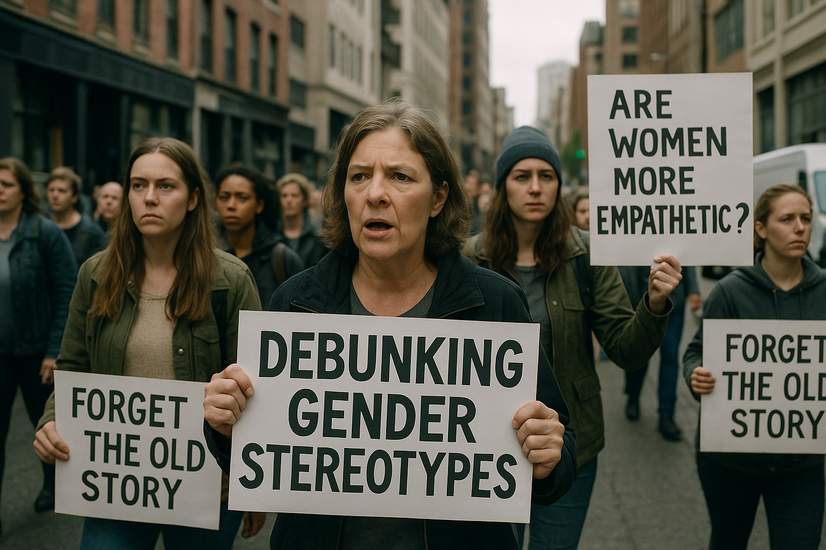
Forget the old ‘women are wired softer’ story
People have been telling tales about gender and feelings for centuries. Back in the 1700s, thinkers suggested that women who accomplished big things were somehow acting like men, and even royalty insisted they could rule “like a king” despite being female. Those snippets of history help explain why we still lump traits into neat boxes labeled “feminine” and “masculine”—with empathy stereotypically shoved into the pink corner.
But modern research is poking holes in that neat packaging. It turns out that the belief “women are born more empathetic” looks a lot more like folklore than a scientific law.
Hormones: one piece of a messy puzzle
Some scientists have pointed to prenatal hormones—especially testosterone exposure before birth—as a factor that nudges brains toward different ways of processing the world. Studies have linked higher fetal testosterone with stronger system-focused thinking and, in some cases, lower scores on empathy tests. That led to headlines about “hard-wired” male and female brains.
But those findings aren’t the final word. They show a correlation, not a neat cause-and-effect map, and many researchers caution against oversimplifying complex development into a single hormone story.
Genes matter… but not much of the story
Large genetic studies indicate that DNA contributes to empathy, but only a small slice of the variation between people is explained by genes. In other words, genes help a bit, but they don’t hand out empathy like a birthright. Importantly, those genetic signals aren’t tied to biological sex, so being born male or female doesn’t come with a fixed empathy quota stamped on it.
Babies aren’t born believing stereotypes
When researchers look at infants, the picture is pretty even-handed: newborn boys and girls don’t show reliable differences in how alertly they watch faces or how they react to others’ cries. That suggests early life experience and culture probably play a much bigger role than any mystical, pre-packaged empathy gene.
Socialization: teaching us how to feel
From day one, kids get nudges about how to behave. Girls usually get more encouragement to be caring and attentive, while boys often get steered toward independence, rough-and-tumble play, and tools. Over time those nudges add up—expectations shape motivation, and motivation shapes performance. If you expect someone to be empathic, they’re more likely to act that way; if you expect them not to, that becomes a self-fulfilling prophecy.
Power, money and the perception of feeling
Power dynamics complicate things further. Research suggests that having more power or status can blunt empathy, while feeling lower in social rank can sharpen your ability to read others. So if men historically held more power, they might appear less empathetic in some settings—not because they can’t care, but because their social position changes what they pay attention to.
Empathy: more trainable than trait
Good news: empathy isn’t set in stone. Brain studies show that people’s emotional responses can change, and behavioral experiments find that both men and women can improve at empathic tasks when motivated—by a reminder, a reward, or a change in expectations. In one experiment, simply telling men that they were just as likely to be caring erased measured gender differences.
When empathy is useful—and when it’s dangerous
Empathy is often praised as an unalloyed good, but it can be wielded for manipulation just as easily as for comfort. Knowing someone’s feelings gives you power in negotiation or persuasion—so empathy can be a tool, not just a virtue.
Real-world consequences matter
Stereotypes about who should be caring influence careers, leadership expectations and mental health. Women are often viewed as less “leadery” because empathy and nurturance are seen as feminine, while men are nudged away from emotional help-seeking, contributing to loneliness and worse outcomes for those who don’t reach out.
Where we’re headed: a kinder, messier masculinity
Thankfully, social norms are shifting. More men are taking on caregiving roles and publicly valuing emotional connection—and that shift opens space for a form of masculinity that includes empathy rather than excludes it. The takeaway? Empathy isn’t a gender monopoly. It’s a skill, a habit, and a social practice that anyone can learn—and the world would be better if more people did.
Quick takeaways
– Differences in empathy between men and women are small, variable, and shaped by many things beyond biology.
– Genes and hormones play a role, but they don’t determine destiny.
– Socialization, power dynamics and motivation are big influences—and empathy can be taught and encouraged.