Meet isometrics: fitness that sits still so you don’t have to
Think sweat-drenched gym selfies are the only route to health? Think again. Isometric exercises are the weirdly effective moves where you hold a position instead of bouncing around — imagine a squat you don’t leave, or squeezing a handgrip like you’re hiding a cookie. Short sessions, three times a week, can actually give your heart and muscles a helpful kick without turning you into a gym rat.
Why people are excited (hint: it’s not just laziness)
Researchers pooled decades of studies — nearly 16,000 participants from trials spanning 1990 to 2023 — and found isometrics produce surprisingly big wins for blood pressure. The typical routine used in the studies is basically four 2-minute holds with short rests, which nets out to about a 14-minute session including recovery time. That’s basically a TV ad break workout.
The science, but in plain English
When you hold a muscle tight, the area gets squeezed. That temporarily reduces oxygen and makes the body send more blood and effort to that spot. When you finally relax, blood rushes back and — over time — the blood vessels adapt, becoming friendlier to lower blood pressure. The repeated on-off drama also recruits more motor units (those little nerve-muscle teams), so you get stronger without lifting heavy things.
How it stacks up against other workouts
In the meta-analysis, static holds beat out cardio, traditional weight training, mixed programs and even HIIT for lowering blood pressure. For context: aerobic workouts lowered blood pressure by about 4.5/2.5 mmHg on average, while isometrics dropped it by roughly 8.2/4.0 mmHg — pretty close to what some blood-pressure meds do. That doesn’t mean you can toss out your running shoes if you love them — cardio still wins for weight loss and stamina — but if lowering blood pressure is the mission, isometrics are a serious contender.
Three simple moves the studies used
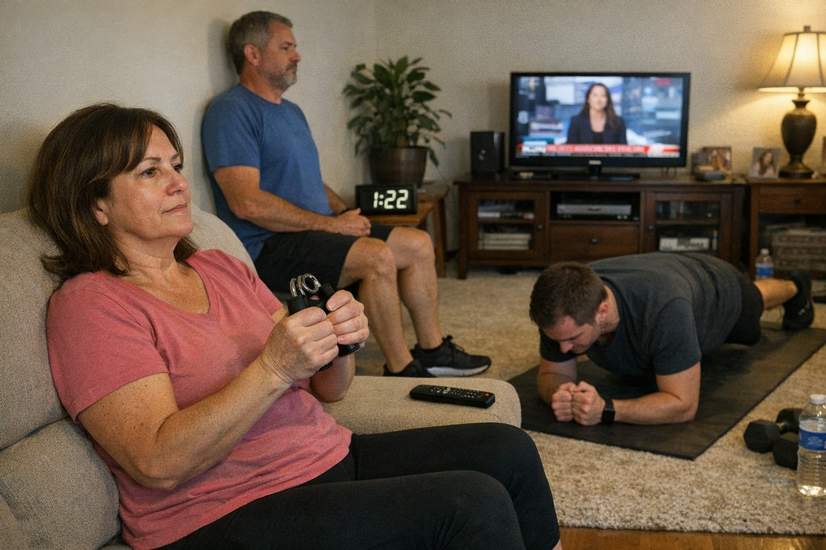
The trials focused on three easy options: squeezing a handgrip device (or a ball), doing a wall squat, and doing a seated leg extension hold. Researchers stuck to the same training plan across studies: short, intense holds with breaks, done about three times a week. Simple, cheap and most of it can be done in your living room while avoiding eye contact with your neighbors.
How to actually get started without regretting your life choices
If you’re new to exercise, this is a gentle way to begin. A practical routine is the same one used in many studies: four 2-minute holds with 1–2 minutes rest between each, three times a week. If two full minutes feels impossible, don’t force it — try a less-deep wall squat (more upright, around 110–130 degrees) so you can handle the time. The evidence mostly uses the 2-minute bouts, so it’s safer to lower intensity (easier angle) rather than chop hold time, at least at the start.
Quick tips and caveats
– Don’t ditch other workouts if you enjoy them — cardio and strength training bring benefits (like VO2 max and fat loss) that isometrics don’t focus on as much.
– We can’t say for certain that every static move works equally well — planks might help, and a small trial suggested a single session of multiple 2-minute planks reduced blood pressure the next day, but more evidence is needed.
– If you’re on blood-pressure medication or have heart issues, chat with a doc before dramatically changing your routine.
Who should try this (and who should be cautious)
Isometrics are great for people short on time, for folks with joint or mobility problems who find running or heavy lifting painful, and for anyone wanting a low-cost, low-fuss way to lower blood pressure. If you’re training for endurance, big weight numbers, or maximal fitness tests, isometrics are a handy supplement — not a full replacement.
The short version
Isometric holds are cheap, quick and surprisingly effective at lowering blood pressure and improving strength. Four 2-minute holds with short rests, done three times a week, is the study-backed template — and it might just be the least dramatic route to a healthier heart. So go on: hold that squat, squeeze that ball, and enjoy getting fitter while doing less moving than you thought possible.