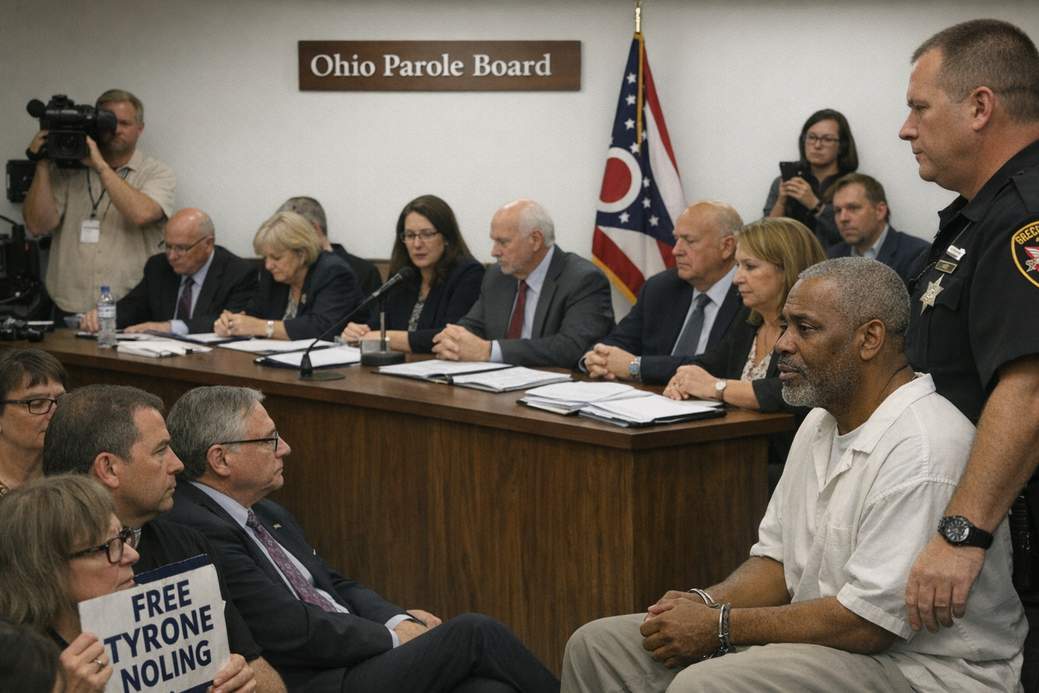
Board recommends life instead of execution
The Ohio Parole Board voted this week to ask the governor to commute Tyrone Noling’s death sentence to life behind bars with a chance at parole — possibly as soon as 2029. Noling has been on death row for about three decades for two killings he says he didn’t commit.
Now it’s on the governor
The recommendation was sent to Gov. Mike DeWine roughly a week after Noling requested a full pardon. DeWine once helped bring the death penalty back to Ohio in the early 1980s, but in recent years he’s publicly questioned capital punishment and urged lawmakers to consider getting rid of it. He can pardon Noling, shorten his sentence, or pause any execution while the case keeps moving through legal channels.
The vote and the drama
Of the eight board members hearing the case, one supported a full pardon, five backed commuting the sentence to life with parole, and two opposed any leniency. The case has attracted high-profile attention — celebrity supporters, true-crime coverage, and a public push from innocence advocates all add to the pressure on officials.
What Noling wants
Noling has been clear: he will not accept life without the possibility of parole. He and his lawyers want complete vindication, not just a lesser sentence — a stance that makes the decision politically and emotionally trickier.
The case, boiled down
Prosecutors say an 18-year-old Noling was part of a gang that burglarized and murdered an elderly couple in 1990. The victims were shot multiple times and their home was ransacked. Noling’s conviction relied heavily on testimony from three teenagers who were minors at the time; those witnesses later recanted, saying police pressured them to name Noling.
Questions about the evidence
There was never a murder weapon found and no physical evidence that definitively placed Noling at the scene. Defense and innocence lawyers later uncovered notes and reports pointing toward other possible suspects, including a man executed years later for a separate killing. DNA testing on a cigarette found at the scene didn’t match Noling or the other teens, and a blood-typing report suggested someone else could have been the smoker — information that wasn’t brought to light during the original trial.
Local law enforcement’s doubts
Former Portage County Sheriff Ken Howe, whose department reviewed the case, said investigators never saw physical proof linking Noling or the teens to the double murder and believes they were wrongly accused. Still, local prosecutors pushed for a grand jury indictment, which ultimately led to Noling’s 1996 death sentence.
What happens next
With the parole board’s recommendation in hand, the ball is in the governor’s court. He can grant a pardon, commute the sentence, delay action, or let the case proceed as is. Meanwhile, Noling’s legal team continues to press for exoneration, and the public and media will likely keep a close eye on every move — because this story has more plot twists than your average true-crime binge.