How a lab hiccup turned into a legendary trip
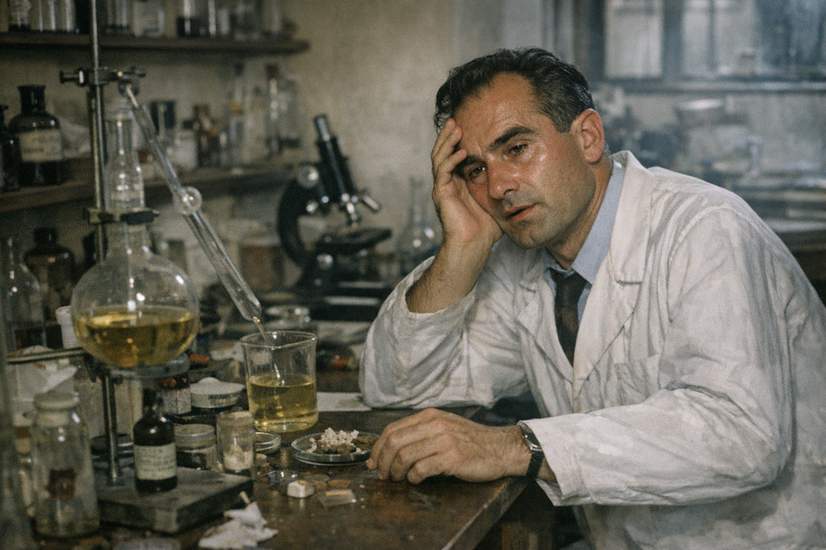
Imagine being a careful Swiss chemist, quietly poking at fungusy plant material in a basement lab, and accidentally inventing a doorway to another reality. That pretty much summarizes how Albert Hofmann first encountered LSD in April 1943. What began as routine pharmaceutical tinkering turned into one of the oddest accidental discoveries of the 20th century.
Warning: this retelling includes descriptions of psychedelic effects.
The accidental taste (or finger?) that revealed the mystery
Hofmann had been working with compounds from ergot, a fungus that grows on grain, trying to help with childbirth bleeding. One day he noticed a strange, dreamlike shift in his mind after handling some crystals. He didn’t set out to get high — he likely got a trace on his skin and felt subtle but unmistakable changes: a sudden sense of wonder, a feeling of being part of everything, and flashes of vivid imagery. It was gentle at first, like glimpsing childhood awe in a lab coat.
The notorious bicycle ride home
Curious and methodical, Hofmann returned to test the compound on himself a few days later. He planned a tiny dose — 0.25 milligrams — but quickly discovered “tiny” wasn’t the right word. Within minutes he felt dizzy and disoriented and decided to bike home. What followed was a surreal commute that’s now celebrated as “Bicycle Day.” Streets bent and colors shifted, furniture seemed animated, and a helpful neighbor delivering milk struck him as something out of a fairy tale — or a witch story. The ordeal lasted several hours, ending only as the drug’s grip slowly loosened.
From lab curiosity to psychiatric tool
Hofmann reported his findings at his employer, and the company began to distribute the substance under a clinical name. Early psychiatrists saw potential: in controlled settings, the drug could open doors to buried memories and emotional material, potentially aiding therapy. Scientists marveled at how a single tiny dose could produce such dramatic effects — Hofmann himself estimated a teaspoon could have affected tens of thousands of people.
When the experiment escaped the clinic
The 1950s and 60s turned LSD into a cultural accelerant. The U.S. military ran covert programs testing it, while writers, artists, and rebels experimented outside lab walls. Figures like Ken Kesey and Timothy Leary championed the drug’s mystical and mind-expanding possibilities — and sometimes handed out doses like party favors. That freeness produced creativity but also plenty of chaos, including frightening “bad trips” that could scar users psychologically.
Regulation, backlash, and the long shadow
As recreational use spread and sensational stories stacked up, governments clamped down. By the early 1970s LSD was restricted worldwide, largely erased from mainstream medicine, and lumped in with other controlled substances. The official view emphasized risks: unpredictable experiences, occasional long-term disturbances, and a cultural panic about mass experimentation.
Hofmann’s mixed feelings and legacy
Hofmann lived to a very old age and never stopped reflecting on what he’d stumbled upon. He worried about careless use but believed the substance itself wasn’t evil — rather, its effects demanded respect and careful context, ideally clinical or ceremonial. He dubbed LSD his “problem child,” curious and troublesome, but also thought it could be a “wonder child” if used wisely alongside therapy or meditation.
Whether you see the story as a quirky lab tale, a cautionary chapter in drug history, or the origin myth of a counterculture, it’s hard to deny the spectacle: a humble chemist, a bicycle, and a tiny crystal that helped change how millions thought about mind and reality.