A medieval treasure chest (but for books)
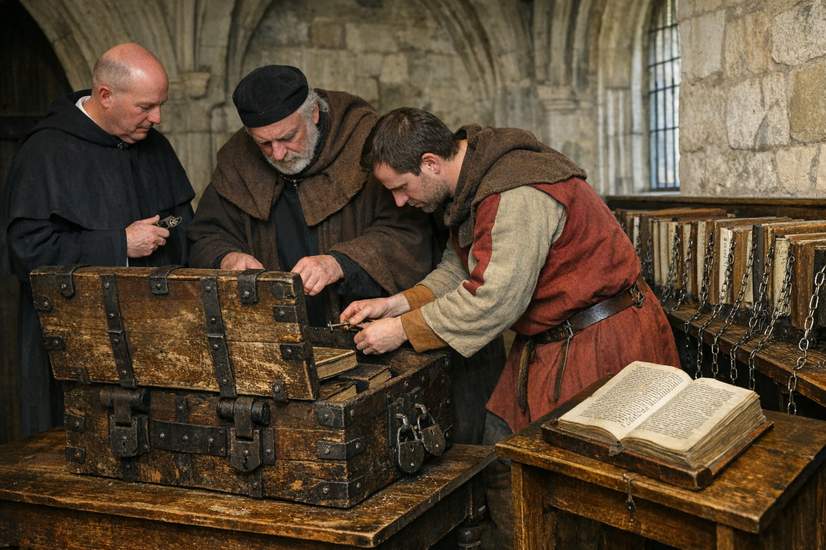
Imagine a heavy oak chest, three people with keys, and no gold—only books. That’s the origin story of Merton College’s library in Oxford. Back in the late 13th century, when the Archbishop ordered fellows to donate books, volumes were rare and costly enough to be treated like precious cargo. The college’s collection grew under strict guard, and that guarded beginning is the seed of a library that’s been in use for seven and a half centuries.
From chained desks to browsing shelves
Early on, the books were literally chained down or locked in the chest so they wouldn’t wander off. Soon after, some books were secured to tables so scholars could consult them any time—an early version of reference books versus loans. In the 1370s Merton built a special room and installed horizontal shelving so books could stand upright. Oddly enough, the spines pointed inward and titles were written on the fore-edge because the chains clipped to the fore-edge; it was practical, if a bit awkward.
Still being used—yes, even by students
Parts of that medieval room survive and students still study there during term. A few of the old chained volumes remain on display rather than in circulation, and most books today sit the modern way with their spines facing out. The continuity of both space and use is what makes Merton feel like a living time capsule rather than a dusty museum exhibit.
Fame, tourists and a little folklore
By the Victorian era, Merton had become a must-see, complete with stained glass, an oak roof and beloved antiquarian treasures like an illuminated edition of The Canterbury Tales. Writers and visitors spread the word, and the library’s reputation snowballed. Over time the polite claim of being one of England’s oldest libraries turned into grander, sometimes exaggerated, boasts about being the oldest in the world.
Who really gets to be “the oldest”?
It turns out that declaring a single library the world’s oldest is messy. What do you count—the founding date, the oldest surviving books, the continuous use of the same room, or the unbroken story of a collection? Different candidates fit different definitions. Some point to Saint Catherine’s Monastery in Egypt; others highlight the historic Al-Qarawiyyin in Morocco, while some scholars mention sealed troves like the Dunhuang cave in China. Each has a strong claim depending on how you slice it.
Definitions matter more than bragging rights
Modern historians are careful to qualify claims. Instead of shouting “oldest,” people now prefer more precise phrasing—like calling Merton “one of the oldest continuously used academic libraries in Europe.” That keeps things honest and opens the door to appreciating libraries on their own terms rather than ranking them like vintage wines.
From parchment to pixels
The library isn’t stuck in the past. Staff are digitising manuscripts so anyone can peek at them online, but the physical room still matters. People want to experience the place where students and scholars have gathered for centuries. Digitisation is another chapter in the long story of how books get shared: chest, chains, shelves, then servers.
The real treasure: community
What’s endured for 750 years isn’t just oak beams and vellum pages—it’s a habit of sharing and preserving knowledge. The original rule asking fellows to donate books created a communal collection, and that idea of a common library has been passed along ever since. Whether those books are sealed in a chest or floating as pixels, the human part—students, scholars, readers—keeps the whole thing alive.
Final thoughts
So yes, Merton’s library is ancient and charming, full of quirks like fore-edge titles and a few chained books for show. But the headline isn’t “oldest” so much as “loved for a long time.” For 750 years people have cared for that collection, used it, and kept its story going—proof that books, in whatever form, are some of the most stubbornly long-lived treasures we have.