Why Taiwan is the Big Deal
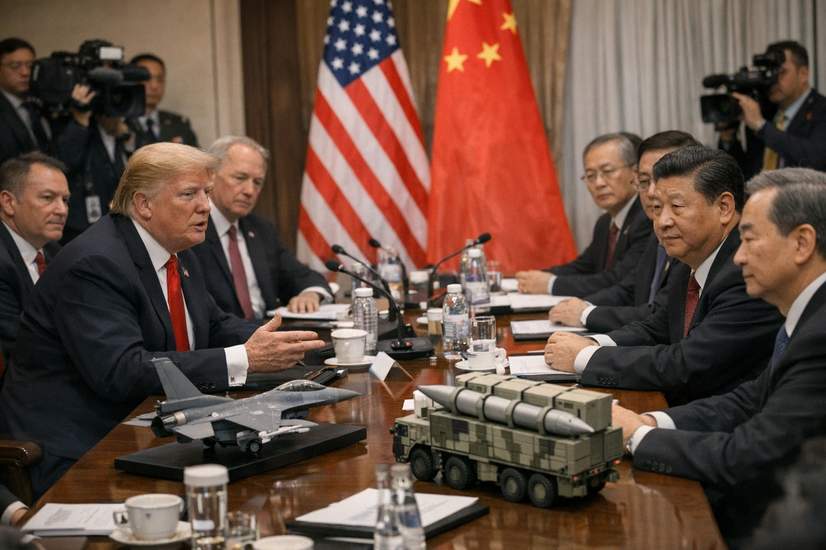
Heads up: when two superpowers meet, you normally expect talk about oil, trade, or global hotspots. But this trip to Beijing has one star of the show — Taiwan. Tiny island, huge geopolitical drama. China views Taiwan as part of its territory, and everything else in the U.S.-China relationship often circles back to who gets to claim it.
U.S. policy: ambiguity… and a lot of weapons
The United States has danced around Taiwan policy for decades with a strategy best described as “strategic ambiguity” — basically, not saying outright whether it would jump into a military showdown if China tried to take the island. At the same time, Washington has quietly been arming Taipei: over time those sales have totaled roughly $50 billion aimed at helping Taiwan defend itself with asymmetric tools.
Recently, the U.S. signed off on an unusually large $11 billion arms sale, which definitely didn’t make Beijing smile. There’s another even bigger package — about $14 billion — sitting on the U.S. desk. President Trump has said he’ll raise this during talks with Xi, which is a break from past practice and worries some in Taipei that long-standing U.S. assurances could get shuffled in the bargaining.
Taipei’s reaction: anxious, but not panicking
Officials in Taiwan are keeping a close eye on the summit. Their deputy foreign minister has emphasized that Taiwan sees the U.S. as a dependable partner and that the relationship is mutually useful — not just politically, but economically: Taiwan is vital to the global tech supply chain, producing about 90% of the world’s leading semiconductors used in everything from phones to defense systems.
So while whispers of diplomatic trade-offs have raised eyebrows in Taipei, senior officials insist they still count the U.S. as a reliable friend — even as they nervously watch what language and concessions might emerge from the meeting.
Beijing’s stance: persuasion, pressure, and a threat or two
From Beijing’s perspective, reunifying Taiwan with the mainland is a top priority and, in their words, “unstoppable.” China has floated the “one country, two systems” approach — the model used for Hong Kong and Macau — as its preferred path, but it hasn’t ruled out using force if push comes to shove. That rhetoric, plus a steady march of military drills in nearby seas, keeps the region on edge.
Timelines, military posture, and the human factor
There’s debate about timetables. Some previous messaging suggested a potential military readiness window in the mid-2020s, but U.S. intelligence assessments recently indicated an invasion is unlikely within the next year. Analysts point to internal shake-ups in China’s military leadership — purges and reorganizations that may have slowed any offensive timetable — but they warn the threat could re-emerge in coming years.
Crucially, the people living in Taiwan matter. Since democratization, many Taiwanese have embraced freedoms like free speech and a pluralistic society and are loath to swap that for the political package Beijing offers. The heavy-handed response to pro-democracy protests in Hong Kong a few years ago only hardened skepticism on the island about any promises of autonomy under Chinese rule.
Bottom line
Expect Taiwan to dominate the headlines from the Trump–Xi summit. It’s a mix of high-stakes bargaining, military signaling, and the everyday realities of proud people who like their democracy. Whatever comes out of the meeting could shift diplomatic language and regional calculations, so even tiny tweaks matter — and Taiwan’s future is definitely not small potatoes.