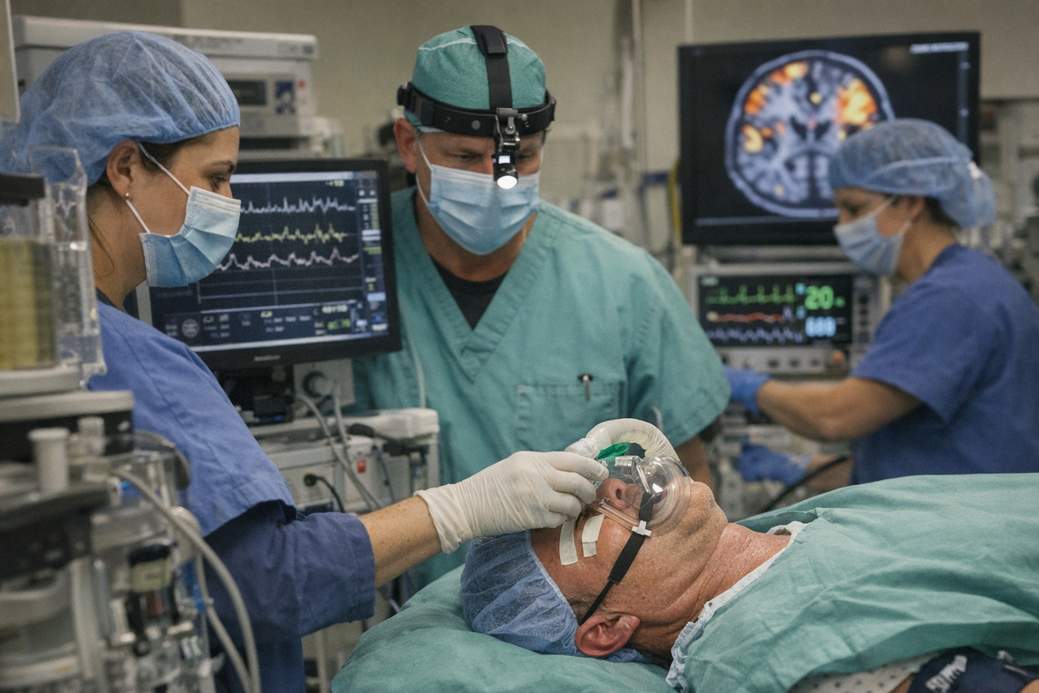
Fast forward from rum to high-tech naps
Once upon a time surgeons wielded saws while patients were wide awake and chewing their courage—Admiral-level rum aside. These days, more than 350 million operations a year happen with people temporarily shut down by drugs we call general anaesthetics. They reliably switch off awareness, but exactly how they do it is still more mystery than manual.
What these drugs actually do (in plain English)
Not all anaesthetics are twins: some only dull pain, others just make you sleepy, and the generals send you into a full blackout. Chemicals as different as noble gases and creamy propofol all end up with a similar result—neurons stop chit-chatting. Brain scans show a broad quieting across the brain, but translating that silence into “no more conscious experience” is where scientists scratch their heads.
Which parts of the brain are the power switches?
Is the whole brain needed to lose consciousness, or are there a few key hub regions that, if dimmed, pull the plug on the rest? One candidate is the thalamus, a compact relay center that seems to nap first under anaesthesia and is important for waking and sleeping. Stimulate parts of it and sleepiness can lift—at least in animals and some coma cases—so it’s likely part of the story.
On the other hand, many researchers point to the cerebral cortex—the wrinkly outer layer involved in thinking and sensing—as the main stage where consciousness plays out. Frontal regions (planning, thinking) and parietal areas (sensory processing) appear especially involved. The honest answer: multiple sites and networks probably conspire to turn awareness on and off.
The surprising “in-between” state
Not everyone dives into a full blackout. A rare few wake up with memory of surgery, and some people can respond in experiments even while seeming clinically unconscious. In one setup a tourniquet kept a hand able to move; some “unconscious” patients still squeezed on command. That suggests there might be more than just awake and asleep—maybe a blurry middle ground where parts of the mind are online while others are offline.
Consciousness as a team sport
One way anaesthetics teach us about consciousness is by showing what disappears when it goes. Researchers using brain imaging looked at how different regions coordinate their activity—a kind of brain chatter map that is usually as unique as a fingerprint. Under anaesthesia, those idiosyncratic patterns fade and brains start to look more alike. The human brain under drugs even becomes a bit less uniquely human, resembling other primates in how regions talk to each other.
That supports the idea that consciousness isn’t tucked away in a single spot but arises from widespread communication across brain hubs. Anaesthetics seem to kill the long-distance gossip between areas, leaving only close neighbors able to whisper.
Anaesthetics vs psychedelics: opposite traffic rules
Interestingly, drugs that expand conscious experience—psychedelics—appear to loosen the usual boundaries and open more cross-talk between regions. So while anaesthetics close lanes on the brain’s information highway, psychedelics throw up detours and new routes. Both change the traffic, but in opposite directions.
Why this still feels like the hard problem
Even with fancy scans and clever experiments, the core question—why coordinated brain activity feels like anything at all—remains Big Science. Anaesthesia is a useful tool because it lets researchers flip consciousness off and on in a controlled way, but turning that on/off switch into an explanation for subjective experience is another leap.
Parting shot (and a plea for an explanation)
As one anaesthesiology researcher put it, our understanding of conscious experience is still rudimentary. If you happen to know the person who can explain how consciousness works, pass them along. The scientist community would happily invite them over for coffee (or propofol-free tea).