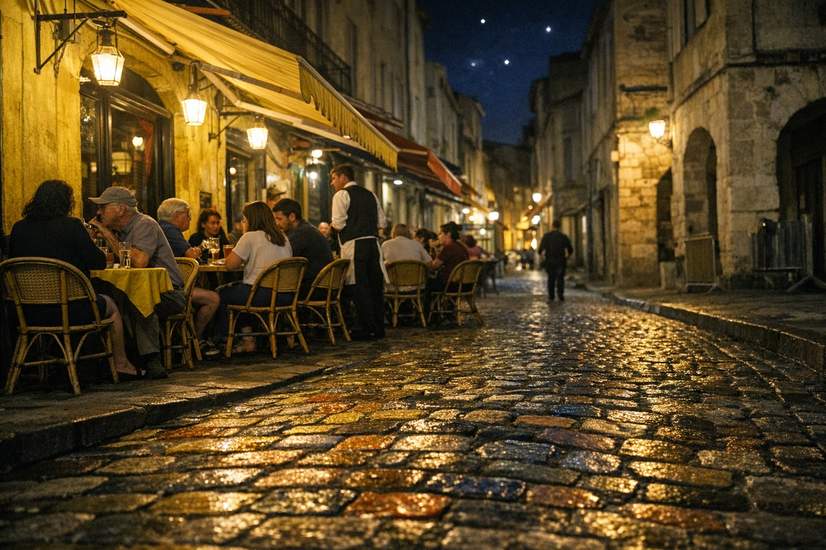
Vincent van Gogh’s Café Terrace at Night (painted in Arles, 1888) is like a secret party where the stars RSVP’d early. It’s not just a cozy scene of people sipping coffee under lantern light — it’s a little optical and emotional trick-box. Below I unpack five small details that turn a simple street scene into something uncanny, magnetic and oddly philosophical.
Intro: Why this painting is sneakily important
Painted months before his more famous Starry Night, this canvas was Van Gogh’s first real dive into “night as theatre.” He wasn’t trying to copy the street; he was remixing it — bright colors, pulsing sky, and just enough mystery to make you squint and think, “Something’s going on here.”
1. The cobblestones: a rainbow that pushes you forward
The foreground is full of multicolored cobbles that seem to ripple. They don’t just anchor the picture — they shove your eye toward the cafe. Van Gogh painted light like paint had a life of its own, turning ordinary pavement into a prismatic runway. It’s playful and a little disorienting, like the ground has remembered a different history and can’t stop showing off.
2. The columns: ancient leftovers, politely ignored
Look closely and you’ll sense a tug-of-war between past and present. Van Gogh replaces heavy historical architecture with simplified storefront shapes, almost like he’s saying, “We know the ruins are there, thanks, but not tonight.” Those ancient fragments still hover at the edges of the scene — visible but politely sidelined — which keeps the painting hovering between now and then.
3. The empty chairs: front-row seats to a vanished performance
Rows of vacant tables and chairs stare out at you like audience members awaiting a show that never starts. The emptiness makes the scene theatrical and a touch eerie — social life is implied, but the action has been paused. That hush hints at darker local stories and the way public spaces remember events long after people forget.
4. The tower: a vertical thread to the past and sky
In the distance a shadowy tower rises and redirects your gaze upward. It’s more than a backdrop; it anchors the painting in place while connecting the human bustle below to the quiet vastness above. The tower acts like a whisper: there’s history here, there’s weight, but the night — and the stars — still have final say.
5. The stars: fixed points in a world of wiggle
Of everything Van Gogh plays fast and loose with, he treats the stars with surprising care. The tiny lights in the sky feel deliberately arranged, steadying the scene’s restless energy. In a canvas where almost everything seems to be shifting, the stars stand in for something constant and a little hopeful — the one thing you can look at and not feel dizzy.
Wrap-up: What it all adds up to
Café Terrace at Night is a small miracle of mood and mischief: bright paint, theatrical emptiness and a sky that refuses to behave. Van Gogh didn’t just paint a street; he invented a mood where the past peeks through the present and a few glowing stars keep everything honest. It’s cozy, eerie and kind of brilliant — like catching a secret smile in the middle of a crowd.