Summer 1944: a pine forest with a loud secret
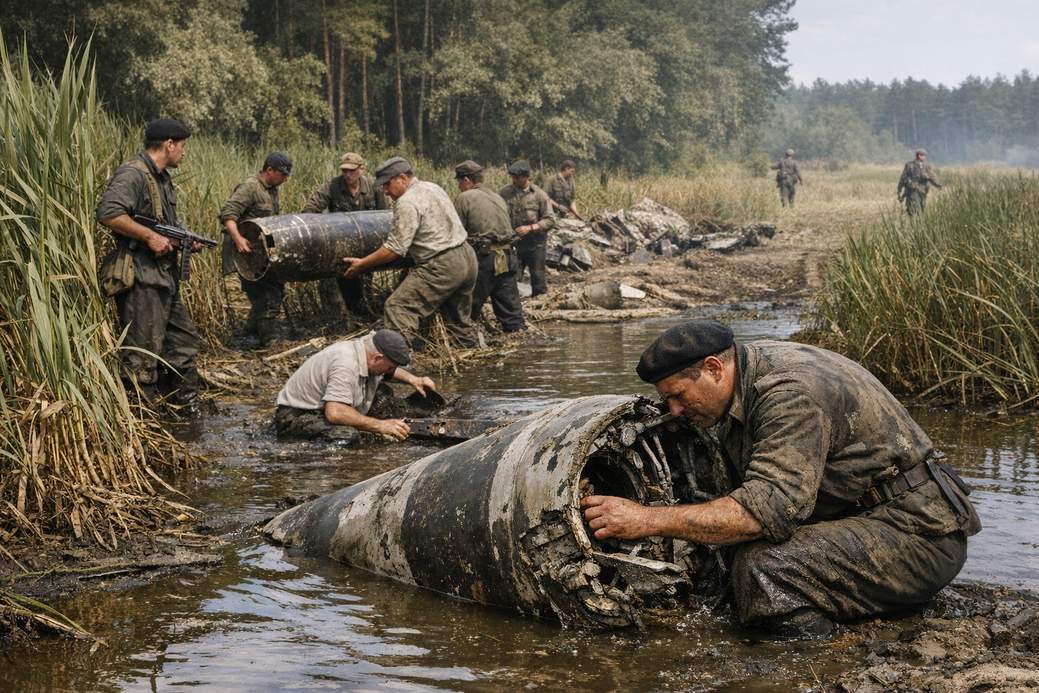
In mid-1944, a quiet patch of Polish woodland near the village of Blizna suddenly became the scene of booming, deadly experiments. The Germans had moved their test launches there after Allied bombing of Peenemünde, firing the new V2 rockets — the first modern ballistic missiles. They looked terrifying on paper: supersonic, high-flying, and packing a one-ton warhead. In practice, though, many of the test shots broke up before reaching their intended targets, littering forests and marshes with wreckage.
Locals get a front-row seat (and a risky job)
The people who lived nearby weren’t thrilled to be target practice. Polish resistance fighters quietly started gathering the wreckage before German recovery teams could reach it. When a V2 came down relatively intact on the bank of the Bug River, villagers covered it with reeds and called in specialists. A team led by Lieutenant Tadeusz Jakobski pulled the parts from the marsh and prepared them for a longer trip — but getting rocket bits from a muddy riverbank to Allied hands required imagination, nerves, and some very clever hiding places.
Smuggling by cart, suitcase and subterfuge
Instead of hauling an entire rocket (which would have required a crane and a miracle), the resistance dismantled what mattered most: electronics, guidance parts, blueprints and other components. These pieces were stuffed into sacks and transported to Warsaw on back roads, under the watchful eyes of partisans in the trees. Because university labs were vulnerable to Gestapo searches, the scientists chose an unorthodox workspace — the apartment of a German officer who had no idea his place was being used as a lab.
To the officer, it was just luggage. To the resistance, the officer’s suitcase was a tiny vault. Physicist Janusz Groszkowski worked for long stretches in the apartment, sneaking in and out while agents kept tabs on the officer’s whereabouts — even arranging his meals to make sure the timing stayed right. It was tense, absurd and strangely domestic: rocket science amid dinner plans.
Operation Wildhorn III: the midnight runway drama
The big extraction was codenamed Wildhorn III (also called Most III). An RAF Dakota, modified with extra fuel tanks for the long flight, touched down on an abandoned airstrip near Wał-Ruda under cover of night. Nineteen suitcases filled with rocket fragments, technical papers and test data were loaded by partisans who had emerged from the nearby woods after an encrypted radio cue.
And then the plane got stuck. Mud clung to the wheels, planks and straw were shoved under landing gear, and desperate hands dug out the bog. At one point commanders considered dumping the cargo and torching the aircraft to avoid capture. After frantic effort — some gasoline, a lot of sweat and a good dose of luck — the Dakota finally clawed its way free and flew to Britain, arriving in London on 28 July 1944.
Why those suitcase-sized bits mattered
Even though the V2 itself was massive — about 14 meters long and weighing over 12 tonnes — the small pieces that reached Britain were priceless. For the first time Allied scientists could study relatively intact components rather than smashed fragments. That direct look showed that the V2 did not have a remote guidance system that could be jammed. In short: there was no clever electronic switch to flip to send the rockets astray. The grim conclusion was that technology alone couldn’t fix the problem; the only true countermeasure was to defeat the launchers and win the war.
Behind the headlines: brave, strange and human
The whole episode reads like a caper: villagers hiding wreckage in reeds, scientists working in the living room of a German officer, and a puddle-plagued plane limping home with the most unlikely cargo. But it was also deadly serious — the intelligence those bits provided helped Allied planners understand what they were up against when V2s began striking cities.
So the next time you think intelligence work is all codebooks and briefcases, remember this: muddy boots, vegetable carts and perfectly timed dinner orders also played a role in one of World War II’s quirkiest and most consequential heists.