Why a tiny print keeps hogging the cultural spotlight
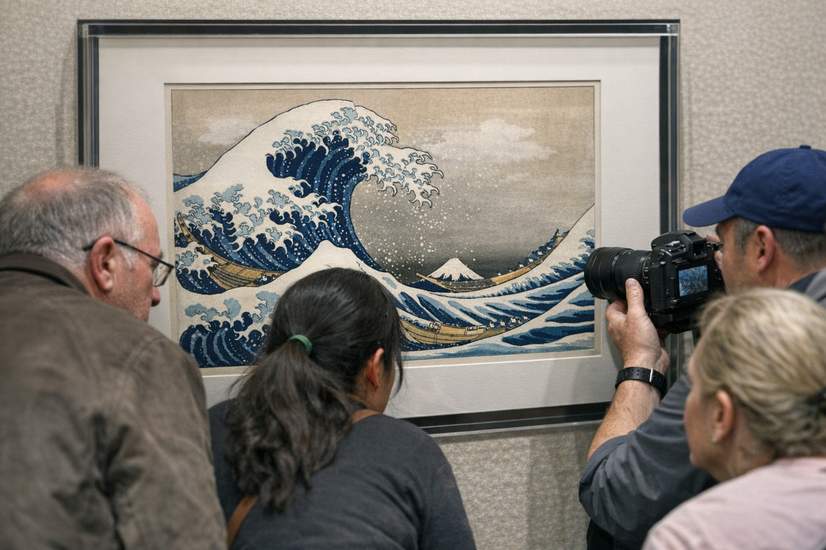
Hokusai’s 1831 print commonly called The Great Wave is basically the poster child of art that won’t stop showing up in your life. It’s bold, blue, dramatic—and weirdly mysterious. People from Van Gogh to emoji designers have peered at it and felt something big, even though the image itself is spare: a towering curl of water, a faraway snow-topped Mount Fuji, and a handful of human figures clinging on for dear life.
That curl looks like claws for a reason: artists and writers since the 19th century have read it as a monsterous force about to snatch those on the sea. But look closer (way closer) and the print starts to act like a trickster, hiding little details that change the whole story.
So… how many boats are actually drowning here?
Contrary to some folks’ memory, there isn’t just one tiny vessel in the print. There are three long, sleek cargo boats—oshio-kuri-bune—jammed into the composition and being bossed around by the wave. They’re not background fluff. Those boats give the scene its human stakes and make the tension personal: it’s not an abstract idea about nature vs. us, it’s people rowing, rowing, and possibly regretting their life choices.
Part of the print’s power comes from that funny vanishing act: Hokusai draws attention to their struggle but also keeps them somehow ghostly, so the viewer alternates between feeling awe and squinting for clues.
This wave doesn’t float solo—it’s part of a whole soap opera
The Great Wave isn’t an isolated hit; it belongs to a series called Thirty-six Views of Mount Fuji. When you see the other prints, the narrative opens up. Hokusai revisits Fuji from every angle, and the other views throw comic relief, foreshadowing, and extra emotion back on the wave. Think of the series as a cinematic universe where Mount Fuji is the recurring star and the wave is its dramatic scene-stealer.
Hokusai made these prints late in life, after a rough patch and a health scare. He got obsessed with Fuji, treating it like a personal muse and a symbol of something eternal—so each little scene becomes a different mood-board for how to look at permanence, danger, and human stubbornness.
Fisherman close-up: fragile, focused, and probably cold
One print in the series shows a lone fisherman wedged on rocks, casting lines into a wild river. It’s intimate compared with The Great Wave’s anonymous crew. The tiny fishing lines, often tethered to cormorants, create a delicate geometry that echoes the triangle of Mount Fuji behind him. Put this print next to The Great Wave and suddenly the anonymous rowers become real people. The calm observer of one scene can become the desperate struggler in another—Hokusai loves flipping perspectives on your head.
Barrels, framing, and the art of playing hide-and-seek
Another print in the set shows a cooper shaping a big barrel in the foreground while Fuji peeks at a distance. That unfinished barrel works like a literal lens and a curtain at once: it directs your gaze to the mountain and also blocks it. If you roll that visual back to The Great Wave, the mountain’s small, snowy presence can be read as either a distant calm anchor or as another foamy peak, depending on how your eye (or mood) reads the scene.
Hokusai delights in these visual jokes: things that both reveal and erase. The wave can top the mountain or make the mountain feel like a motif inside the periphery of catastrophe.
Everything’s sliding around—nothing is fixed
A recurring idea across the series is flux: life, perspective, and even Mount Fuji’s identity are slippery. In one print a mountain’s reflection in a lake shows it snow-capped, hinting at a different season or mood than the surrounding landscape. Hokusai treats Fuji like a shape-shifter—solid one moment, suggestion the next. That mutability feeds right back into The Great Wave: the mountain’s tiny snowy hat could be a peak of foam if you squint, or a steady, immortal presence if you squint differently.
Basically, Hokusai is messing with your expectations. Is nature crushing us, or are we stubbornly stubborn? Is the mountain immortal, or is it just another actor on stage? The series answers: all of the above, and none of the above. It’s deliciously ambiguous.
Where you can see this chaos up close
If you want to peer at all 36 (plus 10 later additions) print versions and watch these visual jokes play out, the Dulwich Picture Gallery in London is showing Hokusai’s Thirty-six Views of Mount Fuji from the luchi Collection. It’s a neat reminder that a single famous image can be a gateway to whole universes of artistic mischief.
Exhibition on show until 17 January 2027.