Quick version (because history doesn’t do summaries kindly)
In August 1945 a plutonium bomb named “Fat Man” detonated over Nagasaki. One of the people who helped put that bomb together was Philip Morrison, a young American physicist from the Manhattan Project. He later spoke about how the bomb came to be used, why it felt unstoppable at the time, and how seeing the aftermath changed him — in ways both intellectual and deeply personal.
Who was Philip Morrison and why was he there?
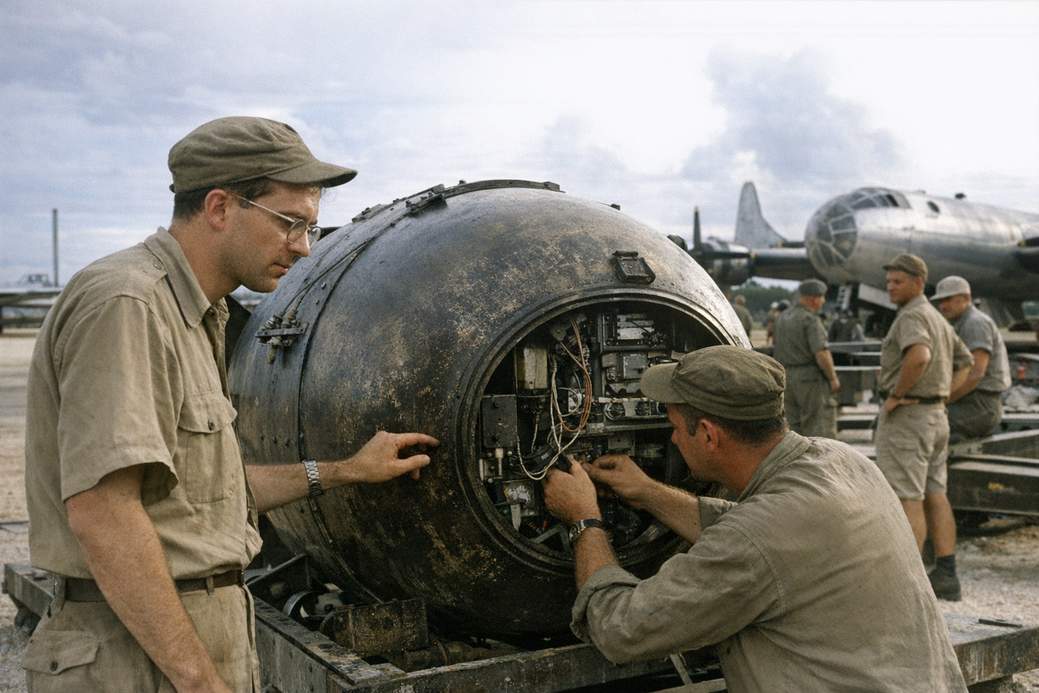
Morrison was part of the secretive brain trust at Los Alamos that built the first atomic weapons. He’d been at the Trinity test in New Mexico and then traveled to the Pacific island of Tinian to help assemble Fat Man and load it onto a B-29. He was one of a few dozen scientists doing what felt like laboratory work in the middle of a war zone — only this lab had runways and bomber crews instead of whiteboards and coffee machines.
Tinian: the weirdest airport you’ve never heard of
Tinian was turned into an enormous airbase — think six runways nearly two miles long, bulldozed coral, and a nonstop parade of B-29s. Morrison described it as effectively the largest airport on Earth at the time. Most bombing campaigns meant thousands of incendiary planes, huge stockpiles of fuel and ordinance, and armies of ordnance personnel. The atomic setup was almost the opposite: small teams from Los Alamos, a few huts adapted as labs, and a single plane carrying a bomb that would change the rules of warfare.
Scale of destruction: same theater, totally different script
Firebombing raids could involve hundreds or thousands of aircraft and lay waste to swathes of city. Morrison noted that a thousand B-29s could incinerate many square miles in a single strike. The atomic bomb, he said, was another animal: one plane, one bomb, and an impact that was both more concentrated and, in some ways, more absolute. He remembered officials in Hiroshima stunned that “all this from one bomb” was possible — and that realization haunted him and others.
Numbers nobody wants to tally
Estimates vary, but tens of thousands died instantly in Nagasaki, with many more dying from burns, injuries and radiation effects in the following months and years. Hiroshima suffered even more immediate casualties. Those numbers are grim to read and even worse to imagine in person; Morrison later toured the devastated sites as part of a scientific damage-assessment team and described the scene as an overwhelming, living reality that numbers on paper couldn’t convey.
The feeling that it couldn’t be stopped
Morrison talked about a sense of momentum — a chain of events and decisions that felt almost impossible to turn around. The Manhattan Project had become a huge, focused national effort. Many scientists had hoped for a non-lethal demonstration of the bomb, but during active wartime that idea felt like a fantasy. Morrison also reflected that the death of President Roosevelt removed a political figure who might have been willing or able to change course; his successor, Harry Truman, learned of the project only after taking office.
Two bombs and plans for many more
Rather than thinking of the Nagasaki bomb as a one-off, plans existed to continue production and, if deemed necessary, to keep using them over time. Morrison said there were schedules and people ready to carry on dropping bombs for months if required. Orders to the field even instructed crews to drop the second bomb as soon as possible after the first — an operational mindset, not a pause-for-reflection mindset.
How seeing changed thinking
Before witnessing the aftermath, much of what the scientists knew was theoretical — calculations, fallout predictions, and grim spreadsheets. After seeing the destroyed cities and the human cost, Morrison and many colleagues felt a different, deeper understanding. He recalled soldiers celebrating after Hiroshima while many scientists sat sullen and unsettled, wrestling with the moral weight of what they’d helped create.
Would they have used it on Germany? (short answer: probably)
Morrison admitted that if the weapon had been ready earlier, the Allies would very likely have used it against Nazi Germany. The project had been driven initially by fear that German scientists might crack the code first, which shaped the urgency and mindset of the work.
After the war: advocacy and regrets
After the conflict, Morrison became a professor and an outspoken critic of nuclear proliferation. He supported warning civilians before such an attack and opposed ongoing use of atomic weapons. He and other former Manhattan Project scientists helped found movements calling for restraint and international control — driven in part by seeing the real, terrible consequences of the bombs.
Parting note
Morrison summed up an uncomfortable truth: many people involved didn’t feel they had the option to stop. For him, that lack of stopping wasn’t as much a triumph as a tragedy — a mix of wartime urgency, organizational momentum, political change, and human fallibility. Looking back, he urged a different path: more warning, more restraint, and above all, fewer moments where technology outpaces our ability to reckon with the results.