Why you’ve probably forgotten her (but shouldn’t)
Believe it or not, Barbara Cartland sold enough novels to make her one of the world’s biggest-selling authors — hundreds of millions of copies — and yet you’re more likely to remember her frocks than her plots. Her name has slipped out of everyday conversation, but her influence on popular romance and celebrity branding was enormous. This is a short, cheeky tour through a life that somehow mixed royalty, rom-com assembly-line production and a penchant for boot-polish eyelashes.
All pink everything (and a diva’s toolkit)
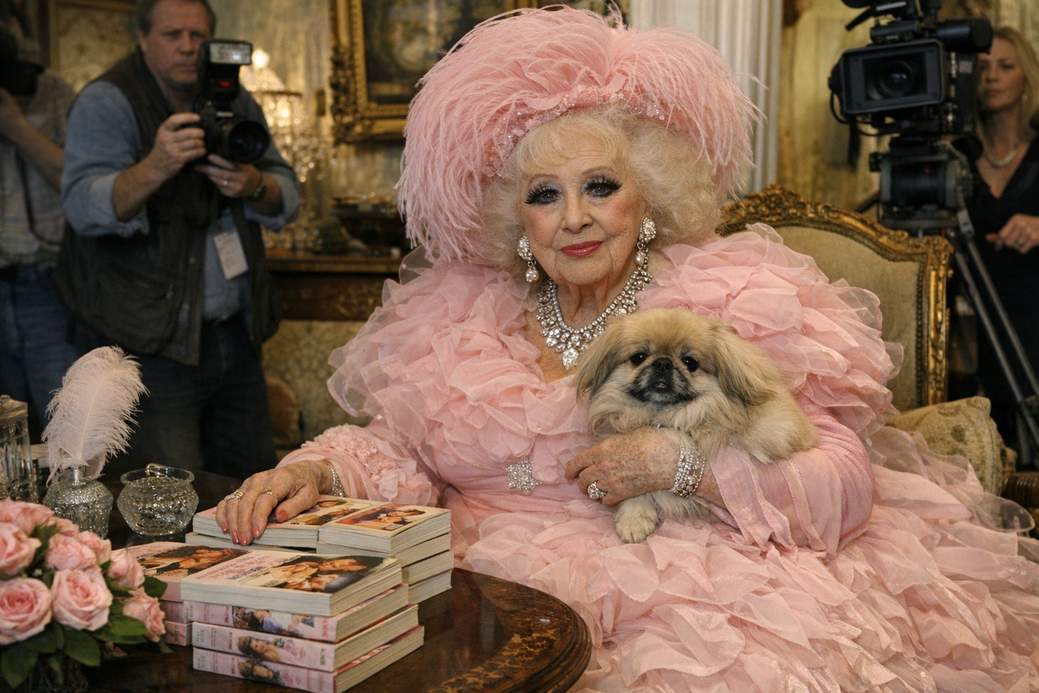
Cartland curated a look so specific it became shorthand: towering dresses in frothy hues, a tiny dog under her arm, dramatic makeup hacks and a public persona that read equal parts fairy-tale author and theatrical socialite. She treated fame like a performance — if a real Pekingese couldn’t join her on a tour, she’d pose with a plush stand-in rather than break the spell. She also ran interviews and biographies like stage directions: tightly controlled, vetted and sometimes re-written to match the image she wanted on stage.
From gossip scribbles to factory-floor romances
Her career didn’t begin in corsets and tiaras. Cartland cut her teeth as a gossip columnist in the 1920s and published her first novel soon after. Over decades she went from contemporary tales to historical escapism, ultimately producing a jaw-dropping number of titles — hundreds of them — often dictating stories to secretaries rather than typing them herself. At her most prolific she was cranking out romances at a pace that would make modern content creators blush.
Not just sugar: early books that annoyed the censors
While later work leaned into a reliable formula (dashing heroes, wide-eyed heroines, guaranteed happy endings), her earlier novels could be surprisingly bold. Some works landed on censorship lists for tackling topics that shocked polite society at the time. In other words: even the woman known for pink could occasionally stir up controversy.
Why so many people loved her
Cartland’s stories weren’t aimed at aristocrats; they were cheap, portable escapism for ordinary readers. At a time when daily life could be grim, her books offered glamour, tidy resolutions and the kind of swoony attention that let readers daydream. She knew her audience and sold them the fantasy they wanted — ritualized, reassuring and always ending on a romantic high note.
Life off the page: tangled, surprising, human
Her personal life was as dramatic as her novels. She had a complicated romantic history, moved in elite circles, and even became connected to the Spencer family by marriage — a link that meant a very young Diana Spencer once tucked into one of her books. Politically she was a conservative who scoffed at parts of the feminist movement, but she also championed causes you wouldn’t expect from a society grande dame, including campaigned support for Romany communities and practical social issues like better care for the vulnerable.
Branding before influencers
Long before social media influencers perfected a look-and-feel, Cartland perfected a persona. She treated publicity as a craft: strict control of interviews, carefully staged appearances and a theatrical consistency that made her instantly recognisable. That sense of a packaged, larger-than-life author helped sell millions of paperback copies across two post-war generations.
Why her books faded from bookstore spines
Popularity doesn’t always equal timelessness. Many of Cartland’s novels were very much of their moment — reflecting desires, norms and comforts that matched specific post-war readerships. As tastes shifted and publishing formats changed, her titles slowly slid out of circulation. That doesn’t erase the fact that she helped define modern romantic publishing and opened doors for the genre to be taken seriously as a mass-market powerhouse.
The paradox that makes her interesting
Cartland loved pomp and tradition, yet sometimes took surprisingly progressive positions. She rejected easy labels: a conservative socialite who campaigned for marginalised communities; a bestselling, formulaic writer who once pushed at cultural taboos. That contradiction is exactly what makes her a fascinating figure — part hustler, part show-woman, all main-character energy.
Where she sits now
These days you’re unlikely to find a Cartland on a new release table, but her influence persists in how romance authors build audiences and brands. A recent in-depth biography, researched from her home archives, digs past the coiffure and the headlines to look at the real achievement behind the pink. Whether you laugh at the glam or admire the grind, Barbara Cartland left behind a strange, storied legacy that’s worth a second look.