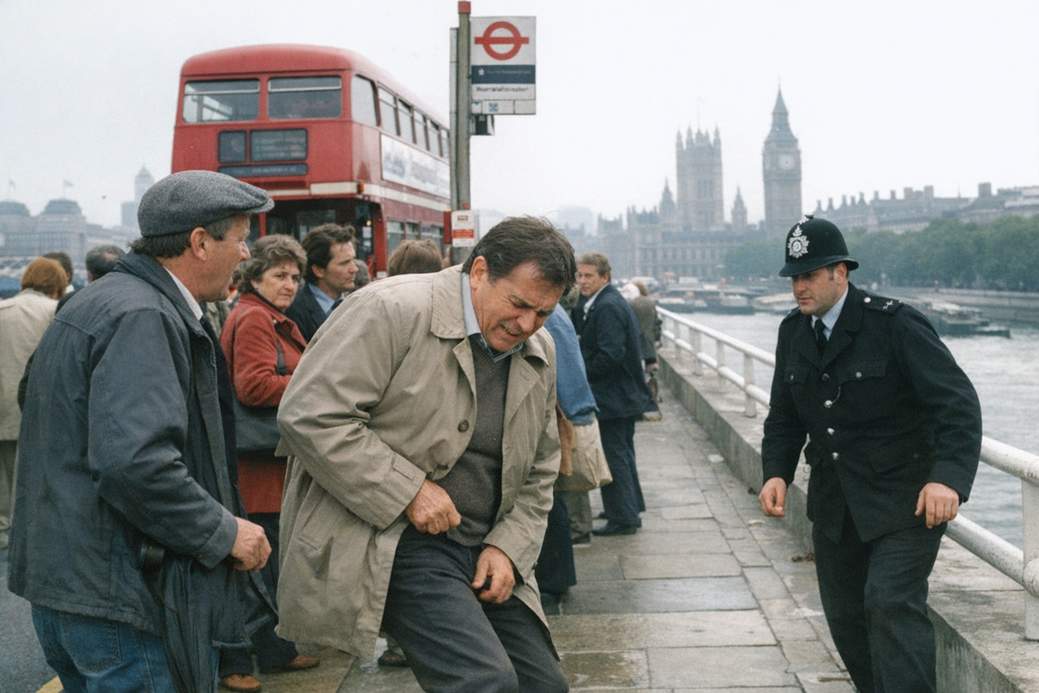
The jab on Waterloo Bridge
On a blustery September day in 1978, a Bulgarian writer and broadcaster named Georgi Markov felt a strange prick in his thigh while waiting at a bus stop on Waterloo Bridge in London. He shrugged it off, then fell ill and, four days later, died. What sounded like a bizarre street scuffle quickly turned into one of the strangest murder mysteries of the Cold War.
The weird little pellet that broke the case
Doctors and detectives eventually found a microscopic metal pellet lodged in Markov’s leg. Under the microscope it looked like something out of a spy movie: a pinhead-size sphere with tiny holes drilled through it. Forensics teams in the UK and France used scanning electron microscopes and found the same tiny metal object in another Bulgarian exile, Vladimir Kostov, who had suffered a similar stab of pain in Paris but survived.
Ricin, Porton Down and the science bit (the gruesome part)
Scientists at Porton Down — Britain’s hush-hush chemical and biological research centre — concluded the pellet had carried ricin, an extremely toxic plant protein. Kostov appears to have been lucky: the pellet lodged but didn’t release enough poison. Markov wasn’t so fortunate. The two pellets turned out to be near-identical, made from a rare platinum-iridium alloy and engineered to avoid rejection by the body — not exactly backyard tinkering.
Warnings, whisperings and a mysterious phone call
Months before the attack, Markov and his family received chilling hints that somebody was gunning for him. An anonymous caller reportedly told relatives that a decision had been made at the highest levels to “eliminate him without trace” (those were the words conveyed to the family at the time). Whether this was bluster or grim foreshadowing, it turned out to be painfully prescient.
Why would someone want Markov dead?
Markov had been a fixture on Radio Free Europe and the BBC World Service, broadcast‑writing about life inside Bulgaria’s elite and spilling stories that embarrassed the regime. His shows painted the inner workings of a government that didn’t like being exposed — and the leader, Todor Zhivkov, reportedly took particular offense at a series that focused on their personal meetings.
Finger-pointing: Bulgaria, the KGB and a very costly umbrella
Detectives and defectors pointed to the Bulgarian state and its Soviet backers. Former Bulgarian and KGB officers, speaking publicly for the first time, said the operation had the hallmarks of professional state tradecraft — too neat and too coordinated to be a lone criminal job. Later, after the USSR collapsed, more testimony surfaced about a KGB-designed umbrella capable of injecting a ricin‑filled pellet. A name that pops up in post‑Cold‑War accounts is an Italian criminal codenamed “Piccadilly,” who was said to have been involved in carrying out the hit.
Timing and psychological effect
The assault on Markov coincided with the Bulgarian leader’s birthday, which some observers took as a not‑so-subtle signature. Beyond removing a dissident, the attack sent a message: distance and Western borders were no shield for critics. One former KGB officer said the operation was designed to terrify exiles and make them question whether any safe space existed.
Open questions and the long tail of justice
Despite the evidence that suggested state involvement, nobody was ever convicted. Bulgaria formally closed the investigation in 2013 because it couldn’t identify suspects; the UK inquiry remains open. The case sits at the awkward intersection of cold‑war politics, scientific sleuthing and international intrigue — part forensic puzzle, part diplomatic hot potato.
Why this story still matters
Markov’s death is a reminder that the Cold War wasn’t just nuclear sabres and spy swaps: it could be small, surgical and deeply personal. A minute pellet and an umbrella became a symbol — of state reach, of technical nastiness, and of how dissent could be silenced in a way that was equal parts theatrical and terrifying. And the whole saga still reads like a grim episode of a black‑humoured spy sitcom: you never expect your umbrella to be a murder weapon, but then again, you also never expect international politics to be so petty and so deadly.
Further reading (a gentle nudge)
If you like outlandish real‑life spy stories, this one checks every box: exotic toxins, tiny engineered pellets, an umbrella straight out of a Bond film, and a mystery that spans London, Paris and the murky corridors of Cold War intelligence. It’s grim, it’s clever, and it’s stubbornly unresolved — the kind of history that keeps whispering back when you think you’ve finished the chapter.